
Autonomous VPS PaaS Control Plane
Wurbr
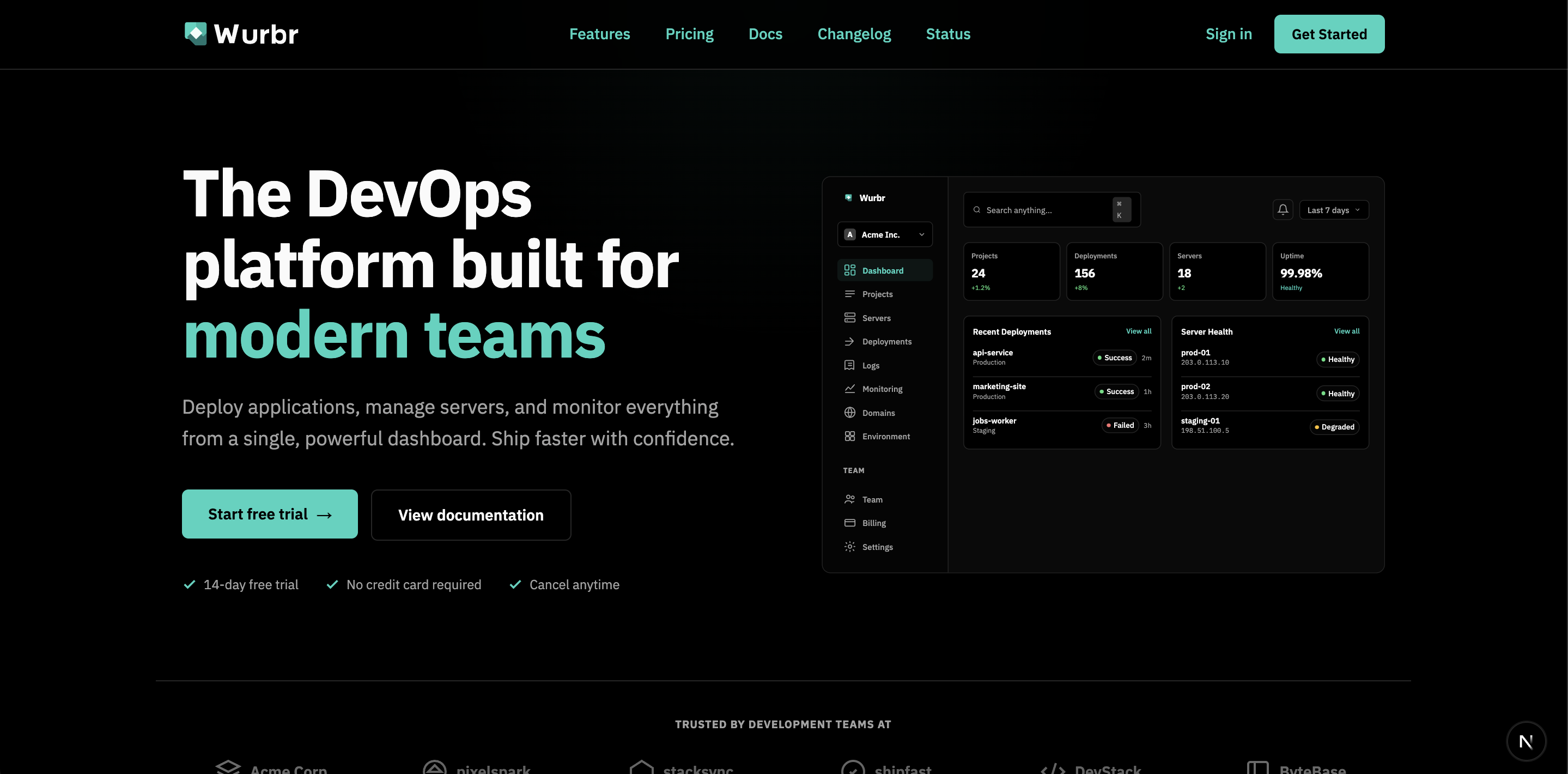
Autonomous deployment and operations control plane for customer-owned VPS infrastructure built with Clean Architecture, Next.js 16, Hono, BullMQ, and PostgreSQL, featuring zero-SSH operations, dual automatic/guided deployment modes, real-time Ably log streaming, AES-256-GCM envelope encryption, and instantaneous rollbacks.
Executive Summary & Core Value Proposition
01 // SECTIONWurbr is a self-hostable control plane that brings the seamless developer experience of modern PaaS platforms (such as Vercel or Render) to customer-owned VPS infrastructure (Hetzner, DigitalOcean, AWS EC2, Linode, OVH, or bare metal).
Key Value Pillars:
- Zero-SSH Operations: Provision, deploy, configure environment variables, manage custom domains, provision SSL certificates, inspect metrics, and stream live logs directly from the web interface.
- Infrastructure Ownership: All application workloads run directly on the user's servers, while Wurbr operates as the control plane orchestration engine.
- Dual Deployment Paradigms: Continuous push-to-deploy Automatic Mode and interactive stage-by-stage Guided Mode.
- Security by Default: Client credentials, private SSH keys, and environment variables are encrypted at rest using AES-256-GCM, with HMAC authentication across webhooks and web terminal sessions.
System Architecture & Clean Architecture Boundaries
02 // SECTIONWurbr is architected as a modular monolith adhering strictly to Clean Architecture (Hexagonal / Ports & Adapters):
• Inward Dependency Rule: packages/domain contains pure business entities, value objects, and port interfaces with zero external runtime dependencies. packages/application coordinates use cases and depends only on domain contracts. Outer packages (packages/database, packages/ssh, apps/api, apps/worker) implement domain ports. • Web & Database Isolation: apps/web never connects directly to PostgreSQL or remote SSH servers. All state operations route through apps/api or shared client DTOs. • Worker Isolation (ADR-0002): All long-running SSH commands, Git clones, builds, Certbot certificate requests, and system metric harvests are strictly offloaded from HTTP request handlers into background BullMQ workers.
Asynchronous Job Processing & Distributed Worker Model
03 // SECTIONAll background workloads are dispatched through BullMQ queues backed by Redis 7:
• Queues & Workers: deployments (builds, pipelines, rollbacks), health (SSH connectivity and host fingerprint validation), metrics (CPU, RAM, Disk utilization harvesting), and domain-ssl (TLS socket handshakes and DNS verification). • Distributed Locking (RedisLockService): Prevents race conditions during concurrent deployments on the same project or server. • Graceful Worker Shutdown: Traps SIGTERM and SIGINT signals, stops accepting new jobs, drains active deployment pipelines cleanly, and closes SSH connection pools safely.
Deployment Engine & Phased Execution Pipeline
04 // SECTIONEvery deployment execution follows a strictly structured lifecycle:
- Prepare: Acquires Redis distributed lock and initializes deployment stages.
- Source: Clones target Git repository or pulls commit to remote staging (/var/www/wurbr/apps/<project-id>/releases/<deployment-id>).
- Detect: Automatically identifies project framework (Next.js standalone, Node/Express/Fastify/Hono, Vite static HTML, Docker/Docker Compose).
- Build: Injects decrypted environment variables, installs dependencies, and runs build scripts.
- Release: Configures systemd unit files or Docker containers, updates reverse proxy configurations (Nginx/Caddy), reloads services, and updates the active /current symlink.
- Healthcheck: Probes the local application port for zero-downtime cutover.
Dual Modes & Rollbacks: Supports fully automated CI/CD alongside Guided Mode (ADR-0017) for interactive command/file editing. Rollbacks (ExecuteRollback) are instantaneous and non-destructive, re-pointing the /current symlink to prior successful releases without rebuilding.
Realtime Telemetry & Ably Log Streaming
05 // SECTIONWurbr provides sub-second visibility into all deployment and server events:
• Scoped Token Issuer (ADR-0007): apps/api generates short-lived, capability-restricted Ably Realtime tokens for authenticated client sessions. • Live Streaming Mesh: apps/worker emits real-time stdout and stderr log lines alongside stage state transitions (deployments:<id>, servers:<id>). • Resilient Fallback: If Ably is unavailable or WebSocket connectivity drops, the frontend automatically falls back to REST polling endpoints (/v1/deployments/:id/logs).
Infrastructure, SSH Gateway & Interactive Web Terminal
06 // SECTIONServer management is handled through a high-performance native SSH gateway:
• Ssh2Gateway: Manages SSH key authentication, host fingerprint verification, and remote command streaming. • Interactive Web Terminal (ADR-0009): The web client requests a single-use 60-second HMAC token from POST /v1/servers/:id/terminal-ticket and opens a WebSocket to apps/worker (ws://.../terminal). The worker allocates an SSH pseudo-terminal (PTY) and pipes input/output bidirectionally to in-browser xterm.js. • Metrics Harvester: Executes lightweight non-interactive SSH commands (top -bn1, free -m, df -k, cat /proc/loadavg) and appends samples to PostgreSQL, with automated 7-day retention pruning and SVG sparkline visualizations.
Custom Domains, DNS Guidance & Let's Encrypt TLS
07 // SECTIONWurbr provides automated domain configuration and TLS lifecycle management:
• Target DNS Guidance: Computes the target server IP and outputs exact A and CNAME record configuration instructions for custom domains. • Automated Certbot Provisioning: Remotely issues and renews Let's Encrypt SSL certificates over SSH with automated Nginx/Caddy renewal hooks. • Continuous TLS Verification: Background workers periodically probe SSL expiration dates and update domain status badges (ACTIVE, EXPIRING, EXPIRED).
Security Architecture & Threat Mitigation
08 // SECTIONSecurity is engineered into every layer of the platform:
• Envelope Encryption at Rest (AES-256-GCM, ADR-0005): SSH private keys, passphrases, and environment variables are encrypted with 256-bit keys and stored as wurbr1.<iv>.<tag>.<ciphertext>. • Session Revocation & JWT Versioning (ADR-0014): Incrementing sessionVersion on user models instantly invalidates all other active JWT sessions upon password reset. • GitHub Webhook HMAC Verification: Validates x-hub-signature-256 signatures with Redis delivery ID tracking to prevent replay attacks. • Immutable Audit Trail: Every critical mutation generates an immutable AuditLog record capturing actor, action, resource, and scrubbed metadata.
Database Architecture & Data Model
09 // SECTIONThe database layer uses PostgreSQL with Prisma ORM structuring multi-tenant entities:
• Tenancy & Membership: User, Organization, and OrganizationMember with granular RBAC roles (OWNER, MEMBER, VIEWER). • Workloads & Infrastructure: Project, Server (with credentialsEncrypted), Deployment, DeploymentStage, DeploymentStep, DeploymentLogLine, and ServerMetricSample.
Highlights
10 // SECTION-
Zero-SSH Autonomous Operations: Complete web-based VPS management for provisioning, deployments, logs, and monitoring.
-
Clean Architecture & Worker Isolation: Strict package boundaries with domain isolation and asynchronous BullMQ job processing.
-
Dual Deployment Modes: Automatic push-to-deploy CI/CD and interactive Guided Mode with live configuration editing.
-
AES-256-GCM Envelope Encryption: Enterprise-grade security for SSH private keys, API secrets, and environment variables.
-
Real-Time Ably Log Streaming & Web Terminal: Live execution output and HMAC-authenticated WebSocket SSH PTY sessions.
-
Instant Symlink Rollback: Millisecond rollback to prior releases without rebuilds or Git fetches.
Outcome & Status
11 // SECTIONShipped an enterprise-grade, open-source self-hostable PaaS control plane delivering modern cloud developer ergonomics directly to customer-owned VPS infrastructure.